



With a time-controlled mixer it is possible!
Water consumption during a shower depends on many parameters: in particular the duration of the shower, the flow rate of the tap, the hose and the shower head.
Let's consider a 4-minute shower, divided into 4 phases.
- The first, in which the user waits a moment (15 sec) until the water becomes hot (38°C).
- Then a minute to get wet.
- The third phase (105 sec) in which the user soaps. During this phase the timed tap is closed.
- The last phase consists of rinsing for a further 60 sec.
It is clear that the user is forced to reopen the tap several times. This 'inconvenience' further shortens the time.
In general, a traditional faucet has a flow rate of 12 to more than 20 litres per minute when fully open. The traditional shower has been calculated with 15 l/min.
The IDRAL tap uses a flow limiter and the flow rate drops to approximately 8 litres per minute.
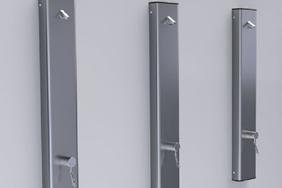
Savings of the water percentage ofIDRAL 08142 - Shower mixer for concealed installation with 15-second time-limited shut-off - compared to a traditional mechanical mixer
The percentage:
Water consumption differs both by the delivery time, i.e. the time in which the water runs, and by the flow rate i.e. the volume that comes out during this time.
The time saving is calculated: 1- (135sec/240sec) = 100% - 56.25%.
The volume/flow rate saved is calculated: 1- (8l/min./15l/min.) = 100% - 53.33%.
The total amount of water saved is: 1- (53.33%*56.25%) = 100% - 30% =70%
In other words: approx. 70% of the water needed to shower with a conventional mixer will be saved with an IDRAL timed mixer !
In our concrete example we would have used only 18 litres of water instead of 60 litres.
Let us continue with our savings calculation by translating this difference in consumption into money.
The cost of a cubic metre of water depends on consumption. Up to 100 cubic metres water has one price, for the next 100 another, and so on. Furthermore, rates vary according to the type of user (resident domestic, non-resident domestic, commercial, etc.) and also according to the area.
Water is a commodity whose cost varies greatly depending on where you live. Milan is among the least expensive cities in Italy, while Tuscan municipalities (including Arezzo, Grosseto, Siena and Livorno) dominate the ranking of the most expensive cities with consumption of 200 cubic metres.
The highest bill (for consumption of 200 cubic metres) is in central Italy, where water costs an average of 2.12 euro per cubic metre (424.44 euro in 2012), followed by the north-east (1.69 euro per cubic metre), the north-west (1.28) and the south-south (1.59). The Italian average is 1.62 euro per mc.
Five different components contribute to the total bill: the fixed fee (on average 7%); the aqueduct service (53%); the sewerage service (13%); the purification service (27%); and VAT. (www.ilsole24ore.com)
Taking our example of the 60 l/traditional shower:
60 litres/1000 litres * 1.62€/mc (Italian average 2012) = 9.72 cent€.
How much does a cubic metre of gas cost and how many cubic metres of methane are needed to heat 42 litres of water of the total 60 litres (to bring it from 15° to 50°)?
The calorific value: 13 284 kcal/kg or 9 530 kcal/Nm³ equivalent to 39.9 MJ/Nm³
These values are only indicative and vary depending on the distributor, depending on the chemical composition of the natural gas distributed to customers, which can vary throughout the year even with the same distributor. A cubic metre of methane thus produces 9530 kcal (kilo calorie = unit of measurement of heat energy). The combustion of one cubic metre of commercial natural gas generally produces about 38 MJ, or 10.6 kWh.
The efficiency of the system that heats water can be less than 50% (when it is a centralised boiler, with a large tank and poor insulation) but as high as 90% when using an instantaneous boiler. Let us consider an efficiency value of 0.8 (i.e. 80%)
A cubic metre of methane yields 7624kcal to water (9530 x 0.8 = 7624)
To raise the temperature of a litre of water by one degree requires 1 kcal, i.e. 35 kcal per 35° (from 15° to 50°).
To raise 42 litres of hot water (traditional mixer / 12.6 litres x the IDRAL tap) from 15 to 50 degrees requires 35 x 42 (12.6) = 1470 kcal (or 441 kcal for the IDRAL tap).
To obtain 1470 kcal would therefore require about 0.193 cubic metres of methane (since 1470 divided by 7624 = 0.193).
To obtain 441 kcal would therefore require approximately 0.058 cubic metres of methane (since 441 divided by 7624 = 0.058).
The average cost of methane from the beginning of 2014 to 2015 was 0.828 euros per cubic metre (www.autorita.energia.it Methane Prices) so in that period heating the 0.193 cubic metres of methane would have cost us about 0.16 euros (0.193 x 0.828 = 0.16).
The cost of methane for heating hot water for the Idral tap would have been 0.048 euro.Economic supply conditions for a family with independent heating and annual consumption of 1,400 m3 c€/m3 at current values.
Conclusion
The cost of water consumed for a shower at 38°C with a traditional tap would have been 9.72€cents for water and another 16€cents for gas energy (Total 25.72€cents)
The same shower with an Idral tap type 08142 would have cost 2.916€cents for water and 4.8€cents for energy (Total 7.71€cents). The savings in money would have been 18€cents per user.
In a gymnasium with 10 showers where each individual shower is used by at least 5 users for 6 days a week for 45 weeks a year: 10*5*6*45*0.18€ = 2592 Euro/year of savings.