



The last two years have seen a drastic change in the way designers address the specifications of public toilets, from the importance of touchless technology to the planning of space to accommodate social distancing.
The public bathroom can no longer just be functional, but must make users feel comfortable and safe, like at home.
But what are the trends for the future?
We talk about this with Luca Papini, the brilliant designer who developed Idra's Otto electronic series.
Public bathroom design has come a long way in recent years and toilets are a major factor in the perception of the building in which they are located, becoming a key expression of hygiene and safety in offices, hotels, restaurants, entertainment venues and even government buildings. What trends are you observing in the design of these spaces?
The most obvious trend is that of colours and the use of different materials, wallpaper and natural materials, a mixture that identifies the personality of the premises. Perhaps the public is not yet so in line with the trends being adopted by private individuals, but there is certainly a growing trend towards this.
The last two years have seen a dramatic change in the way architects and designers address the specifics of public toilets, from the importance of touch-free to planning the space to accommodate social distancing. With the pandemic, how has the concept of the public bathroom changed?
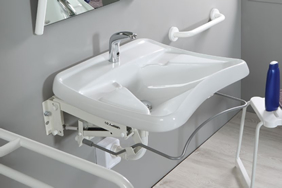
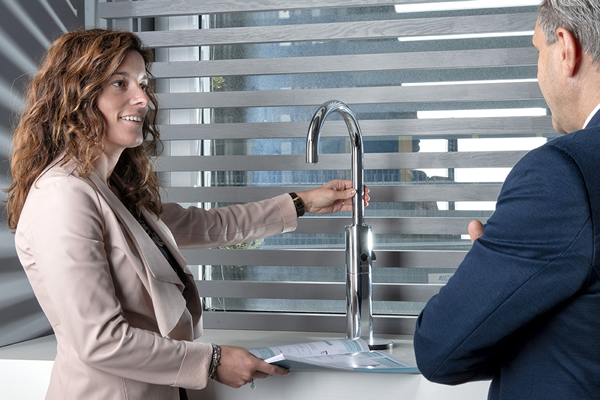
The need to adapt public bathroom spaces to the Covid emergency also generated the opportunity to redevelop outdated environments and gave an input to the incorporation of modern solutions. Electronic faucets are certainly one of these changes as they have been assimilated and adopted more and more. We have witnessed the need for the use of disinfectant dispensers, the electronic tap in addition to its function of saving and defending water waste makes it easier for you to use the tap without having to touch it. We are therefore heading for a new era where these new provisions will be increasingly important and the public is also becoming more demanding.
The bathroom is one of the most frequented spaces in any public or commercial building. For this reason, designers no longer see the public bathroom as just a functional space, but also as an opportunity to create a welcoming yet original ambience. In your opinion, what role does aesthetics play in public bathrooms?
The same as it does in the home: the bathroom is a place where we all spend time, and the private sector has indulged in selecting special tiles and sanitary ware that make the environment in line with its idea of a comfort zone. This is inevitably mirrored in the public bathroom where the user, who enters because he is shopping or shopping, or because he is a guest in the hotel or restaurant, expects to encounter the same comfort he found in the club, the room or the supermarket bar. If the guest finds a modern and functional bathroom, he will be a guest who returns happy and feels that the environment he is in is comfortable.

In 2021, he collaborated with Idral in the development of a new series of electronic taps called 'Otto'. How did the Otto series come about and what makes it special?
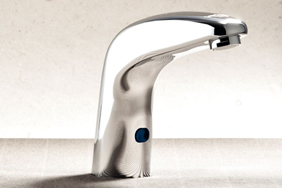
The OTTO series was born out of the need to create a compact, softly shaped faucet. In addition to the technological aspect that Idral confirms it has in its know-how, my intention was to start a collaboration and design a tap that could expand and develop new markets through a product that was elegant and also intended for private environments such as homes or the HORECA world.
The Otto series combines style with the performance of Idral products. How can this series contribute to creating public bathrooms that offer great performance on both the functional and aesthetic side?
The theme you raised that links function with aesthetics is a very important one when designing.
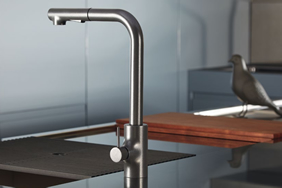
First of all one is linked to the other, you always have to look for a balance. Function in this case is represented by the water, by the possibility of having less waste with a photocell control of the delivery. Aesthetically, on the other hand, thanks to the different metal finishes and colours in the catalogue, we can realise different combinations so that the tap can match the different styles of the interior design project.
Otto electronic faucets are available in various finishes such as chrome, white, matt black, gold, nickel and rose gold/copper in a brushed finish, and it is possible to request two-tone customisation. How important is colour in the modern bathroom concept?
The use of colour with regard to taps began in the 1980s, it is a historical recourse, a bit like in the field of fashion we often look into the past by interpreting styles to our times. Colour becomes the protagonist not only on walls but also in sanitary ware in furniture and finishes. There is a need to develop new metal-related finishes or simple PVD coatings to ensure a range of both glossy and matt colours so that the designer has a wide range of possibilities.
Downloads and resources
Download the OTTO electronic faucet data sheet, brochure or contact Idral for more information, special colours and finishes and customisation.